
Pennsylvania law requires hospitals to test for nine conditions (see bullets below). Infants also are given hearing screening tests and a pulse oximetry to measure the amount of oxygen in their blood.
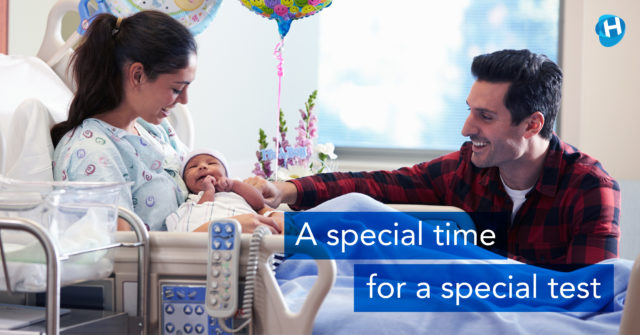
What is your newborn getting screened for?
A baby born with a serious medical or genetic disorder may appear perfectly healthy at birth, so the screenings allow for early warnings, additional testing, and if needed, appropriate treatment.
Pennsylvania’s Newborn Screening and Follow-Up Program requires screening and follow-up for the following serious, sometimes life-threatening, medical conditions:
- PKU, Phenylketonuria—These babies cannot digest a specific part of food protein
- MSUD, Maple Syrup Urine Disease—These babies cannot digest certain amino acids
- Hb SS Disease, Sickle Cell Anemia—These babies have distorted red blood cells
- CH, Congenital Hypothyroidism—These babies lack a thyroid hormone
- CAH, Congenital Adrenal Hyperplasia—These babies have a defective enzyme
- GALT, Galactosemia—These babies cannot digest a simple sugar in breast milk
- GAA, Glycogen Storage Disease Type II (Pompe Disease)—These babies inherit a disorder that prevents the body from breaking down a complex sugar called glycogen
- MPS I, Mucopolysaccharidosis Type I (Hurler Syndrome)—These babies lack an enzyme to break down certain long chains of sugar molecules
- X-ALD, X-linked Adrenoleukodystrophy—in these babies, certain enzymes don’t function properly, resulting in fatty acid buildup
Pennsylvania covers the cost of the mandated screenings. Pennsylvania also maintains a list of 29 non-mandated tests, commonly called supplemental screenings. If they are completed, the results must be reported to the Department of Health.
Additionally, hospitals and birthing facilities may screen for 50 or more disorders, so it is important to talk to your health care provider and hospital about what options are available and how they relate to your personal history.
You should consider supplemental newborn screenings if:
- You have a family history of an inherited disorder
- You have previously given birth to a child affected by a disorder
- An infant in your family died because of a suspected metabolic disorder
- You have another reason to believe your child is at risk for a certain condition
The cost of supplemental screenings might be covered by your insurance, so talk with your doctor, hospital, and insurance provider long before your due date.
What happens during a newborn screening
Before leaving the hospital after birth, usually when a baby is 24 to 48 hours old, several small drops of blood will be taken from a prick on the heel. The blood is placed on a special paper and sent to a lab for testing. Results are sent to your health care provider, the hospital, and the state Department of Health in about seven to 10 days. No additional blood is needed to test for any supplemental screenings you choose.
Retesting
Sometimes a test needs to be repeated if the blood sample is too small or if it was completed before your baby was a day old. If you need a retest, it’s important to return as soon as possible to the hospital where your baby was born.
Screening results
Don’t panic if a test result comes back abnormal. These are screening tests, not diagnostic tests. It does not necessarily mean your child has a disorder. It only provides early information that must be followed with more specific testing, which your baby’s doctor will discuss with you.
Most of these newborn screening disorders are rare, but they can cause mental and physical difficulties, serious health problems, and even death if not diagnosed and treated in a timely fashion. The earlier a problem is identified, the earlier treatment can be started, giving babies the best chance at life.